A symmetrical guide for nonprofit leaders navigating modern tools with old-fashioned integrity.
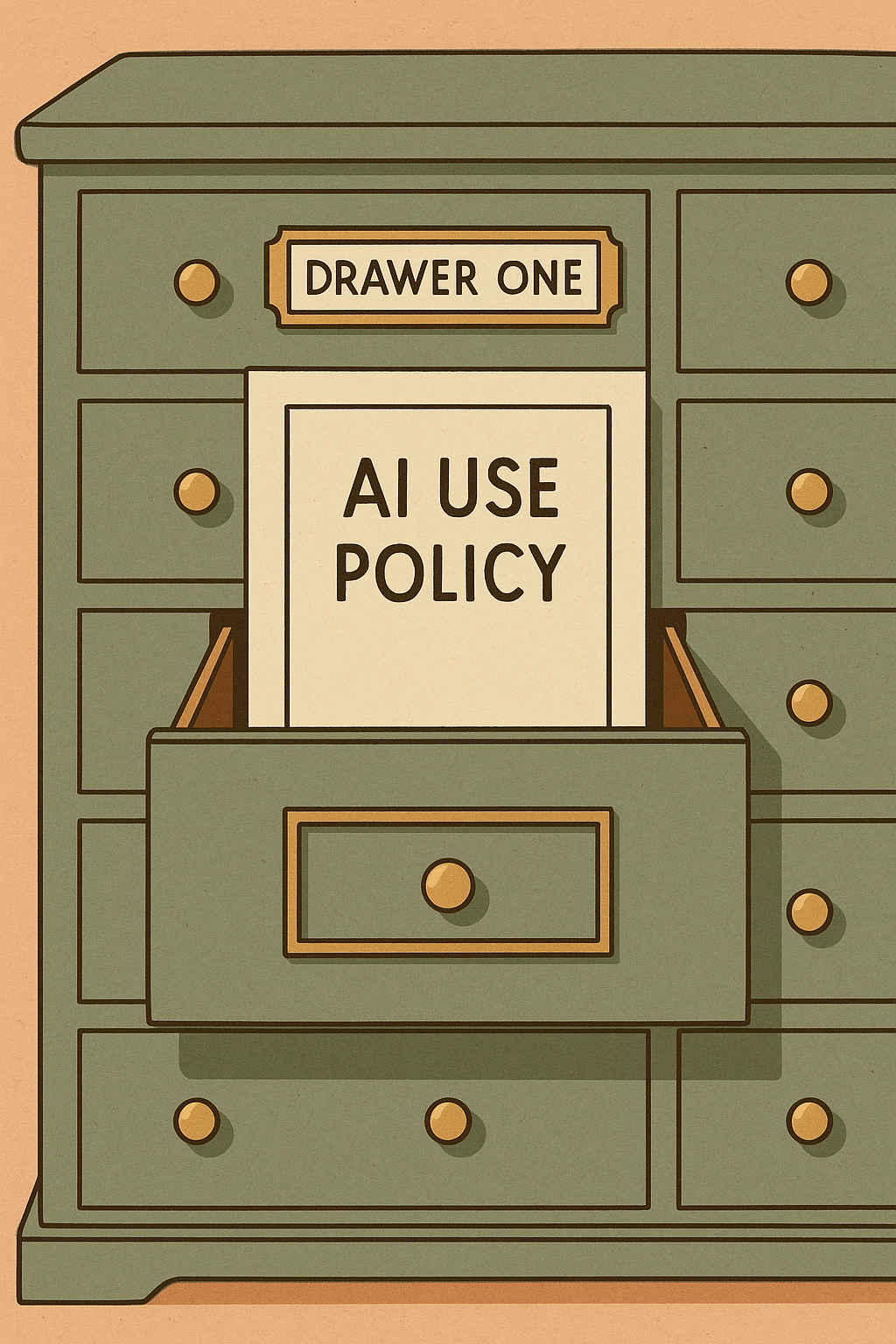 DRAWER ONE: The AI Use Policy
Where everything begins with a label, a boundary, and a well-sharpened pencil: Your AI Use Policy
There’s something wonderfully calming about the idea of a labeled drawer.
You open it, and everything inside has its place. No guessing. No digging.
Just clarity.
AI in the nonprofit world needs that same energy.
We’ve seen organizations sprint into AI adoption the way a teenager approaches spring cleaning: lots of enthusiasm, plenty of improvisation, and absolutely no idea where anything will go when they’re done. And that’s where the real risk begins.
Without a clearly labeled drawer (i.e. an AI Use Policy) tools get used unpredictably, staff assumptions run wild, and privacy becomes a matter of crossed fingers. Even well-meaning teams slip into “We’re trying this and see what happens,” which works fine for assembling IKEA furniture, but not for donor communications or sensitive program data.
So Drawer One holds the most essential tool in the chest: a simple, accessible, human-centered AI Use Policy.
THE PROBLEM
AI is entering nonprofit work sideways through inbox drafts, grant outline builders, meeting summaries, and social media prompts. Staff use it quietly, tentatively, individually. Some love it. Some distrust it. Most are somewhere in the mushy middle.
The issue?
Everyone is using AI differently.
Some enter too much information.
Some rely too heavily on first drafts.
Some don’t realize what tools should never touch personal data.
And leadership has no clean inventory of what’s being used or why.
What starts as an experiment becomes a risk – one misplaced donor name, one hallucinated statistic, one cultural misstep away from confusion or diminished trust.
THE SOLUTION
A clear, friendly, non-bureaucratic AI Use Policy that documents:
1. Where we use AI
Drafting internal notes, summarizing meetings, generating options, cleaning messy text.
2. Where we don’t use AI
Entering personal donor data, confidential program information, health records, financial details, or anything private.
3. Approved tools only
A short, curated list updated quarterly (your AI Steward will live in Drawer Six).
4. Required human review
AI may assist, but humans make the final decisions.
5. Ethical expectations
Accuracy, fairness, dignity, and alignment with your mission’s values.
A good policy isn’t restrictive, it’s empowering. It helps teams move quickly with guardrails instead of slowly out of fear.
A PRACTICAL EXAMPLE
A staff member needs to write a donor thank-you letter. Instead of crafting from scratch, they open your approved AI tool and ask:
“Draft a warm, mission-focused thank-you letter. Keep it in the voice of our organization. This is a first draft only.”
Because of the policy, they know:
- They cannot enter the donor’s name.
- They must review the draft and personalize it.
- They must fact-check any program claims.
- The tone must reflect your organization’s warmth and integrity.
AI becomes a quick drafting partner, not a ghostwriter.
Staff feel supported, not replaced.
Trust stays intact.
THE DRAWER ONE TEMPLATE
AI USE POLICY — STARTER TEMPLATE

1. PURPOSE
To outline how artificial intelligence (AI) tools may be used responsibly, ethically,
and safely within our organization.

2. APPROVED USES
• Drafting internal notes and summaries
• Brainstorming ideas
• Rewriting or clarifying internal content
• Creating outlines or structure for documents

3. RESTRICTED USE
• DO NOT enter names, personal donor information, financial details,
health information, or client stories.
• DO NOT use AI to send messages directly to stakeholders without human review.

4. APPROVED TOOLS
[List tools your organization allows, updated quarterly.]

5. HUMAN REVIEW
All AI-generated content must be reviewed by a staff member for:
• Accuracy
• Tone alignment
• Fairness & representation
• Mission fit

6. ETHICAL STANDARDS
AI use must reflect:
• Privacy protection
• Accuracy and truth
• Respect and inclusivity
• Our organizational values

7. REPORTING
Concerns, errors, or unusual outputs must be reported to the AI Steward.
Drawer One is the organizational equivalent of tidying your desk before writing a letter. It sets the tone. It defines the rules. It ushers in calm.
When staff know how to use AI – and how not to use it – the entire organization becomes more confident, more consistent, and more protected.